


17 GW of new electricity demand. A huge opportunity for Southern Company?

Southern Company has signed contracts with large customers for more than 17 GW of capacity, roughly a third of its current generation fleet. The capital plan has grown to $81 billion and the company promises earnings growth of 8 to 9 percent per year. Yet the stock has lost a fifth of its value since February. Where is the catch between contracted capacity and actually paid-for electricity?
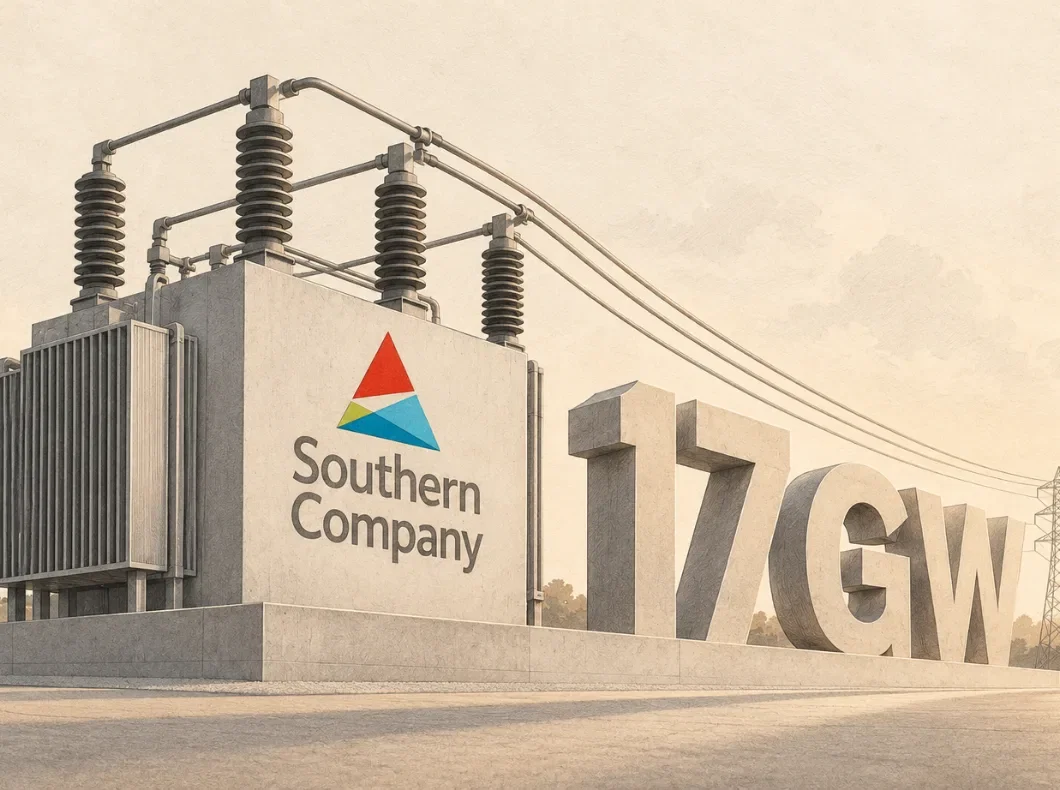
Key points
17 GW of contracted capacity is not 17 GW of consumption. About 1.2 GW is actually running, the rest is a ramp into the mid-2030s.
The $81 billion capital plan drives rate base up by 9% annually and targets EPS growth of 8 to 9% through 2028.
The largest single contract is 3.2 GW for OpenAI near Savannah, for 25 years, with ramp-up from 2028.
Financing is the bottleneck. A cheap government loan helps, convertible bonds threaten dilution of up to 29.4 million shares.
The market is skeptical. The stock is down 18% since February, analyst targets range from $78 to $104.
After two decades of stagnant consumption, growth has returned to the U.S. power sector, and in the Southeast it takes a quantifiable form. Southern Company $SO, one of the largest regulated utilities in the U.S. with about nine million customers, said on its second-quarter 2026 earnings call that it has signed contracts with large customers for more than 17 gigawatts of capacity with ramp-up by the mid-2030s. Another roughly 8 GW is in late-stage negotiations, and the total pipeline of potential projects is estimated at more than 75 GW. For comparison, the entire regulated generation fleet of Southern Company today has about 46 GW of capacity.
The investment relevance is therefore straightforward. At a regulated utility, earnings are not driven by commodity prices or margins, but by the size of the so-called regulated asset base, i.e., the volume of invested capital on which the regulator allows a certain return. If Southern actually builds tens of gigawatts of new sources and transmission, the base grows, and with it earnings per share. The company therefore raised its five-year capital plan to $81 billion and its outlook for adjusted EPS growth to 8 to 9 percent per year through 2028.
At the same time, the stock has fallen roughly 18% since February 2026 from a high of $100.83 and traded around $82 at the end of September, just above its 52-week low. The market clearly does not buy the AI demand story without reservations.
What 17 GW really means
A contract is not the same as consumption
The most important distinction right at the start. The 17 GW figure describes contracted capacity, not actual consumption. Southern Company had about 1.2 GW of actual data center load on its system in the second quarter of 2026. Data center consumption rose 55% year-over-year in the second quarter and 49% for the first half, an impressive pace but from a low base.
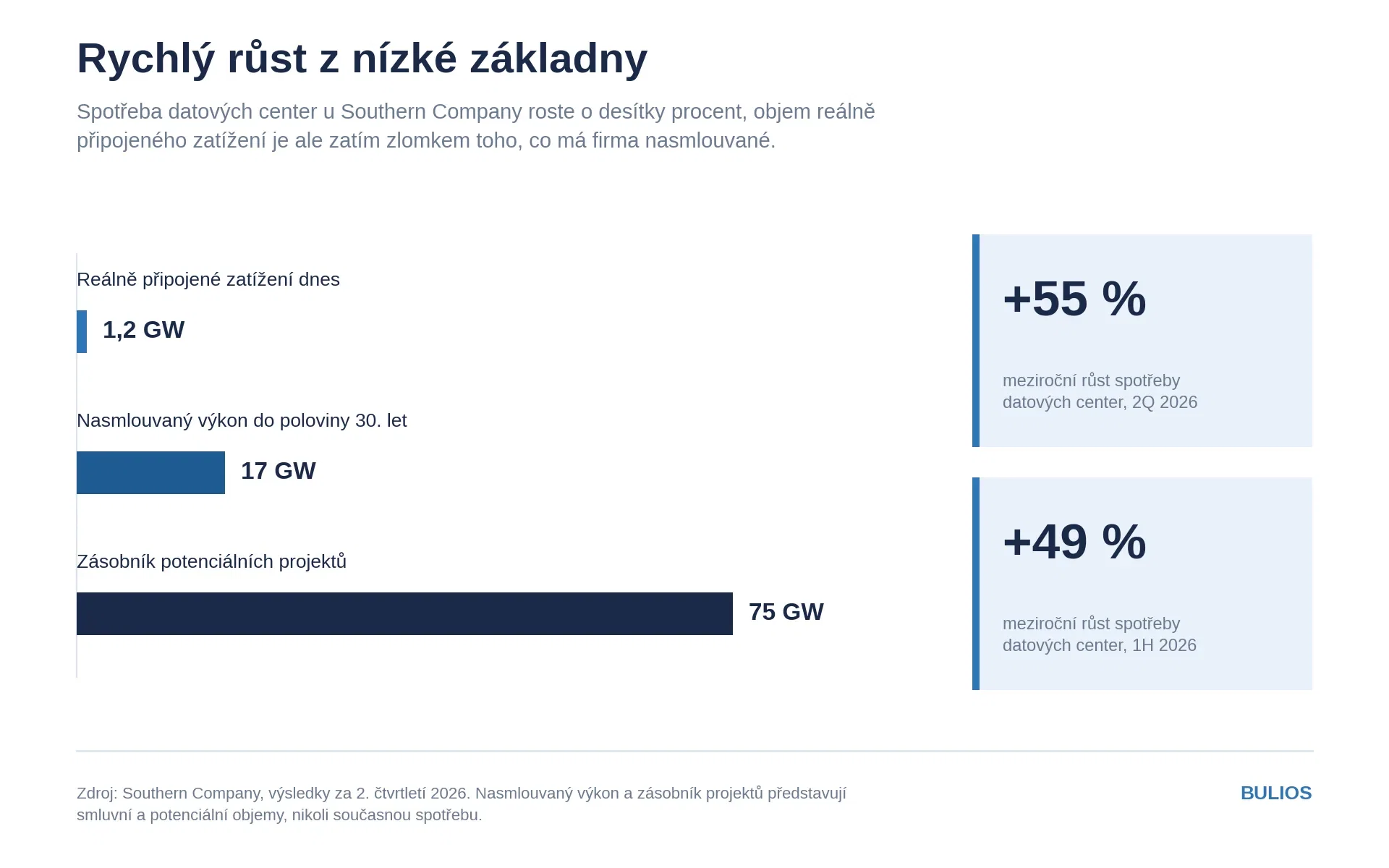
The gap between 1.2 GW today and 17 GW in the mid-2030s represents a decade-long ramp during which three things must happen at once. The customer must build the facility, fill it with chips, and have a reason to turn them on. Each step has its own risk profile and investors should not lump them together.
The structure of the 17 GW, based on available information, looks as follows:
About 15 GW is in Georgia, i.e., at the subsidiary Georgia Power
In Q2 2026 about 6 GW of new contracts were added, of which roughly 3 GW at Alabama Power across three projects
The largest single item is the OpenAI contract for 3.2 GW in Effingham County near Savannah
Another about 8 GW is in late-stage development and does not yet enter the 17 GW figure
The 75 GW pipeline is a marketing number, not a forecast
A prospective pipeline of more than 75 GW should be read as a list of interested parties, not a construction plan. The history of the last two years shows how quickly these numbers change. In Q3 2025 the company spoke of a pipeline over 50 GW, a year earlier of a significantly smaller volume. The growth of the pipeline alone says nothing about the conversion rate.
An interesting counterargument appeared directly in a shareholder proposal included in Southern Company's 2026 proxy materials. The author claims that in one of the previous quarters the company reported a withdrawal of 14.3 GW of data center projects and a net decline of 6 GW in the queue of applicants. It is necessary to emphasize that this is the proponent's assertion, not a figure from the earnings presentation, and that it stands in tension with the subsequent growth of contracted volume to 17 GW. The company has not publicly explained this discrepancy, and for an investor it represents a clear question for management.