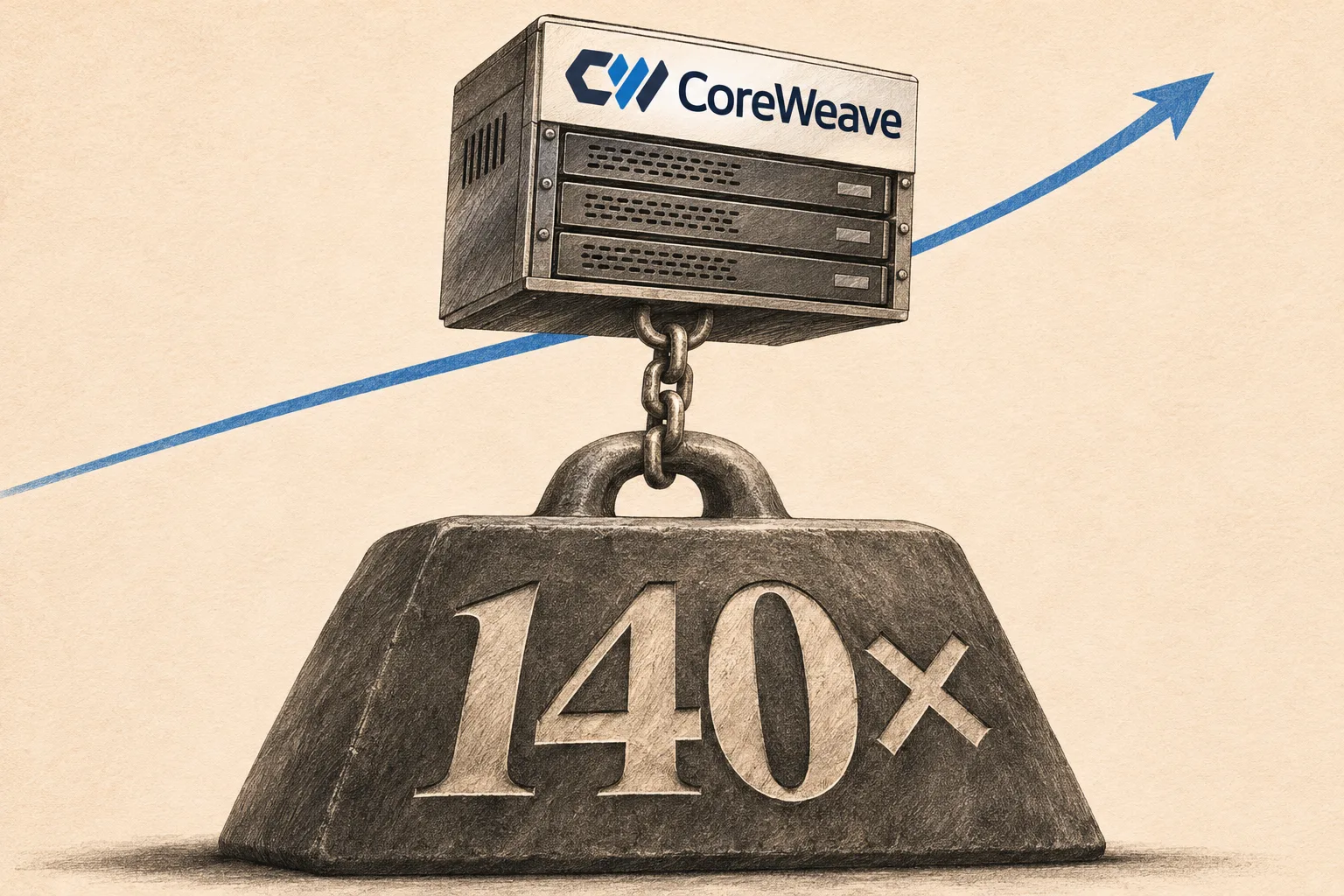
CoreWeave shares surged by a quarter. Yet the company pays 140 times more in interest than it earns

The AI chip landlord reported record revenue, and its shares gained more than 25% in a single day. But over nine months, it paid banks and creditors $2 billion while earning just $14 million from operations.
Key points
CoreWeave shares jumped by roughly a quarter in a single day.
The company paid $2 billion in interest over nine months, while earning just $14 million from operations.
It is not expected to turn a profit until 2028 at the earliest, and Wall Street's biggest skeptic has not changed her mind.
The jump was driven by third-quarter results that beat analysts' estimates and the company's own forecast. But look a few lines below revenue, and you'll find a figure that doesn't quite fit the celebration.
A company that lends out chips and borrows even more itself
CoreWeave $CRWV does something fairly simple. It buys the most powerful chips from Nvidia $NVDA in bulk, builds data centers for them, and then rents out computing power to companies that train and run AI. Demand is enormous, but every new data center costs billions, and that money has to come from somewhere.
The company borrows it. At the end of September, its balance sheet showed nearly $47 billion in debt, more than three times the revenue it expects this year. And debt comes with interest payments.
CoreWeave paid $2 billion in interest in the first nine months of the year, compared with $841 million over the same period last year. Operating profit - what the company earns from its ordinary business before paying interest - was $14 million over the same period. Interest payments are roughly 140 times higher.
Q3 2026 | Q3 2025 | |
|---|---|---|
Revenue | $3.66 billion | $1.37 billion |
Interest paid | $846 million | $310 million |
Net loss | $709 million | $110 million |
The table shows the problem. Revenue grew 168%, but the net loss increased more than sixfold. Nearly a quarter of everything the company brings in now goes toward interest. And things are set to get worse: for the final quarter of the year, management itself expects interest payments of between $1.05 billion and $1.15 billion.
Why investors bought anyway
On Wednesday, the market wasn't celebrating the numbers themselves. It was mainly celebrating the fact that the worst-case scenario hadn't come to pass.
At the start of November, the cost of insurance against the company's default had climbed to a level commonly seen in the bond market as a sign of serious trouble. Investors feared that CoreWeave wouldn't be able to find more money to build, or would only be able to borrow at a ridiculously high interest rate.
Company CEO Michael Intrator responded with unexpected directness on a call with analysts.
"Going forward, at current yields, we will not finance our business in the unsecured bond market. And we don't need to."
Michael Intrator, CoreWeave CEO, Q3 2026 earnings call
In other words: he no longer wants to issue expensive bonds backed by the company as a whole. The money is supposed to come from two other sources.
Customer prepayments. In the next three months alone, the company expects to collect roughly $9 billion in subscriptions and prepayments under contracts already signed. This year, it collected upfront payments on 70% of its contracts.
Loans tied to specific contracts. A bank lends money to build a data center that already has a tenant, with the chips and the customer's future payments as collateral. These loans cover 70% to 100% of costs and are cheaper. The average interest rate on the company's total debt has fallen to 7.9%.
On top of that, CoreWeave is raising prices. It increased them by roughly a quarter in July, then by another 10%, and customers are still lining up. According to Intrator, the company has ten times more serious prospects than it has available capacity through the end of 2027. Its signed backlog reached $132.5 billion, ten times this year's revenue.
What needs to go right
The plan sounds reasonable, but it has several weak points that one good quarter won't fix.
First, construction isn't slowing down. The company raised the low end of its planned investment range for this year to $37 billion to $39 billion. That's three times its revenue for the entire year. So debt will keep growing, just in a different form.
Second, some of the money comes at shareholders' expense. The company raised $4.2 billion in the quarter from bonds that can convert into shares, and launched a program that lets it sell up to 35 million new shares on the market over time. Every new share means a smaller slice of the company for existing shareholders.
Third, the customers paying those prepayments are themselves mostly losing money for now. Management says that more than 75% of planned investment through 2027 is backed by contracts with large, financially strong companies. The rest comes mainly from AI labs that rely on investor money.
And fourth, profits are a long way off. Even by its own estimate, the company won't turn a profit until the first half of 2028, and then only on an adjusted basis that excludes items such as stock-based employee compensation.
Wall Street's biggest skeptic hasn't backed down
CoreWeave's loudest critic is Bernstein analyst Madison Rezaei. In October, she cut her price target from $74 to $51 and kept her rating at the lowest level. After the results, she acknowledged that the quarter could hardly have been better. But she hasn't changed her mind.
"We cannot shake our long-term fundamental concerns about this business model."
Madison Rezaei, Bernstein analyst
Her concern goes beyond a single quarter. CoreWeave's biggest customers are tech giants that are building their own data centers. Once they have enough of them, they will have no reason to rent someone else's, and customers will become competitors.
The rest of Wall Street is much more positive, and most analysts recommend buying the stock. This wide spread of opinion explains why the share price swings tens of percent in both directions. Before the results were released, it was roughly 65% below its May high, and even after Wednesday's jump, it was still down for the year.
CoreWeave remains a bet with very little room for error. If customers keep paying upfront, banks keep lending against contracts, and prices for computing power hold up, the company can grow its way out of debt. But if even one of those three wheels starts to falter, the interest bill of more than a billion dollars per quarter will still come due.
Stocks mentioned