Nvidia is looking for a replacement for Huang, according to Bloomberg. Shares fell another 8%

Nvidia's board has hired an outside firm to identify a successor to Jensen Huang. The man who has led the company for 33 years could be out within days. Around $600 billion is vanishing from Nvidia's market value.
Key points
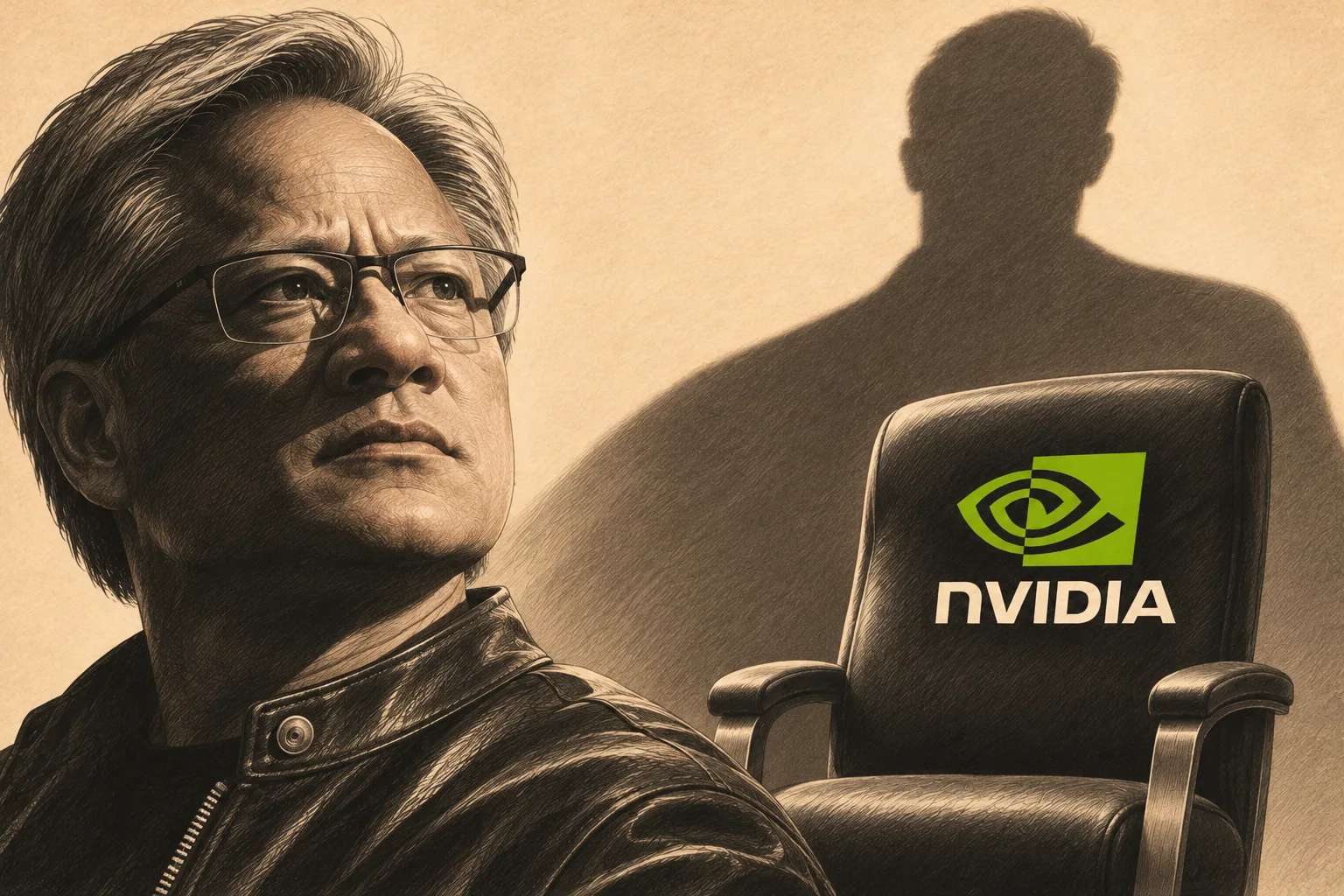
Nvidia has hired an outside firm to look for a replacement for Jensen Huang, according to Bloomberg.
Shares fell another 8.6% after the market closed, and around $600 billion is vanishing from the company's value.
Huang owns just 3.58% of the shares, so the board can remove him by a simple majority vote.
The Wall Street Journal reported the same day that the board was preparing to remove Huang. Reuters then confirmed through a source that directors met on Wednesday evening and discussed his future. As of Thursday morning Central European time, Nvidia $NVDA had announced no decision and had not commented on the reports.
Shareholders didn't wait. The share price fell 8.6% after the market closed to around $158.80.
Four days that shook the most important company of the AI era
The scandal began in late October, when American media reported intelligence agencies' concerns about Huang's contacts with executive Alice Huang (they are not related). She works at Singapore-based Megaspeed, one of Nvidia's major chip buyers in Southeast Asia, which US authorities are investigating over suspicions that advanced chips are being sent to China through the company. The New York Times reported that US intelligence agencies suspect her of working with the Chinese government. Both Megaspeed and Nvidia deny any wrongdoing, and Beijing also rejects the espionage allegations.
On Sunday, November 8, Huang admitted in an email to employees that he had been unfaithful to his wife. He did not name her.
“I am fully committed to Nvidia and will work to earn back your trust.”
Jensen Huang, Nvidia founder and CEO, email to employees dated November 8
The board announced an independent investigation the same day to determine whether Huang had become the target of a foreign intelligence operation. It appointed former federal prosecutor Joon Kim of law firm Wachtell Lipton to lead it. It also said it had no reason to believe national security or company secrets were at risk.
“The board has confidence in Jensen and his leadership.”
Nvidia's board, statement dated November 8
That statement lasted three days. On Wednesday, the New York Times, citing current and former employees, reported that Huang had also had a relationship with one of Nvidia's senior executives, who reports directly to him. Neither the company nor the executive commented on the report, and Reuters was unable to independently verify it. Even so, this puts the board in a different position: a relationship between a boss and a subordinate is a problem in itself, regardless of the outcome of the China-related investigation.
What happened to the share price
Day | Share price at close | Change |
|---|---|---|
Friday, 6 Nov. | 186.64 USD | |
Monday, 9 Nov. | 178.67 USD | -4.3% |
Tuesday, 10 Nov. | 168.89 USD | -5.5% |
Wednesday, 11 Nov. | 173.73 USD | +2.9% |
Wednesday, after the market closed | approx. 158.80 USD | -8.6% |
If Wednesday evening's drop is confirmed in regular trading, the share will be about 15% lower than before Sunday's admission and roughly a third below its October peak. Since the investigation was announced, the company, valued at around $4 trillion, will have lost about $600 billion in market value.
The market is now pricing in more than just the risk that Huang will leave. According to Armina Rosenberg of Minotaur Capital, which owns Nvidia shares, investors are beginning to price in the company without its founder as a likely scenario.
“Losing Jensen would be a real blow.”
Armina Rosenberg, portfolio manager and co-founder of Minotaur Capital, to Reuters
On Wednesday, the odds on the Polymarket betting platform that Huang will resign or be removed by the end of the year jumped to 88%.
A founder who can be removed by a simple majority
Many famous founders hold shares in their companies with special voting rights, making it practically impossible to oust them against their will. Mark Zuckerberg at Meta is a typical example $META. Huang has no such protection.
According to this year's proxy statement, he owns 3.58% of Nvidia's shares, and each share carries one vote. The board has 11 members, all independent except for Huang, and the company's bylaws allow it to remove the CEO by a majority vote, even without giving a reason.
Even so, it is a huge stake. At Wednesday evening's price, Huang's stake is worth around $138 billion. It has fallen in value by approximately $24 billion since Friday.
Who could take over Nvidia
This is the company's biggest weakness. Huang has led it since it was founded in 1993, and since its IPO, the share price has risen by more than 700,000% under his leadership. But he has never named a clear successor. Around sixty people report directly to him, and Nvidia has no board chair, only a lead independent director, lawyer Stephen Neal.
Names circulating in recent hours:
Colette Kress - chief financial officer, in the role for more than ten years. According to Semafor, some board members want her as interim CEO
Ian Buck - head of the data center division and creator of the CUDA software platform, which underpins Nvidia's lead. The betting markets' favorite
Johny Srouji - head of hardware development at Apple $AAPL. According to Semafor, one of the names being considered from outside the company
The company has confirmed none of this. Funds that own the shares also warn that finding an interim CEO is easy, but finding someone to decide what chips Nvidia will make in five years is much harder.
It's interesting to see how competitors reacted to the news. AMD shares $AMD gained around 4% after the market closed, while Broadcom $AVGO rose 3%. CoreWeave $CRWV, a cloud provider built on Nvidia chips, lost 6%.
Earnings are due next Tuesday
The timing could not be worse. According to its previously announced schedule, Nvidia is due to report third-quarter results on Tuesday, November 17. The next day, the heads of three US House committees want to see Huang at a closed-door hearing.
Nvidia's quarterly figures are among the most closely watched events in the entire market, because investors use them to gauge how quickly companies are spending on artificial intelligence. This time, who comments on them will be just as important. For the first time in 33 years, that is uncertain.
Stocks mentioned