Four major IPOs are up to 76% below their offering prices. Which one has a chance to recover?

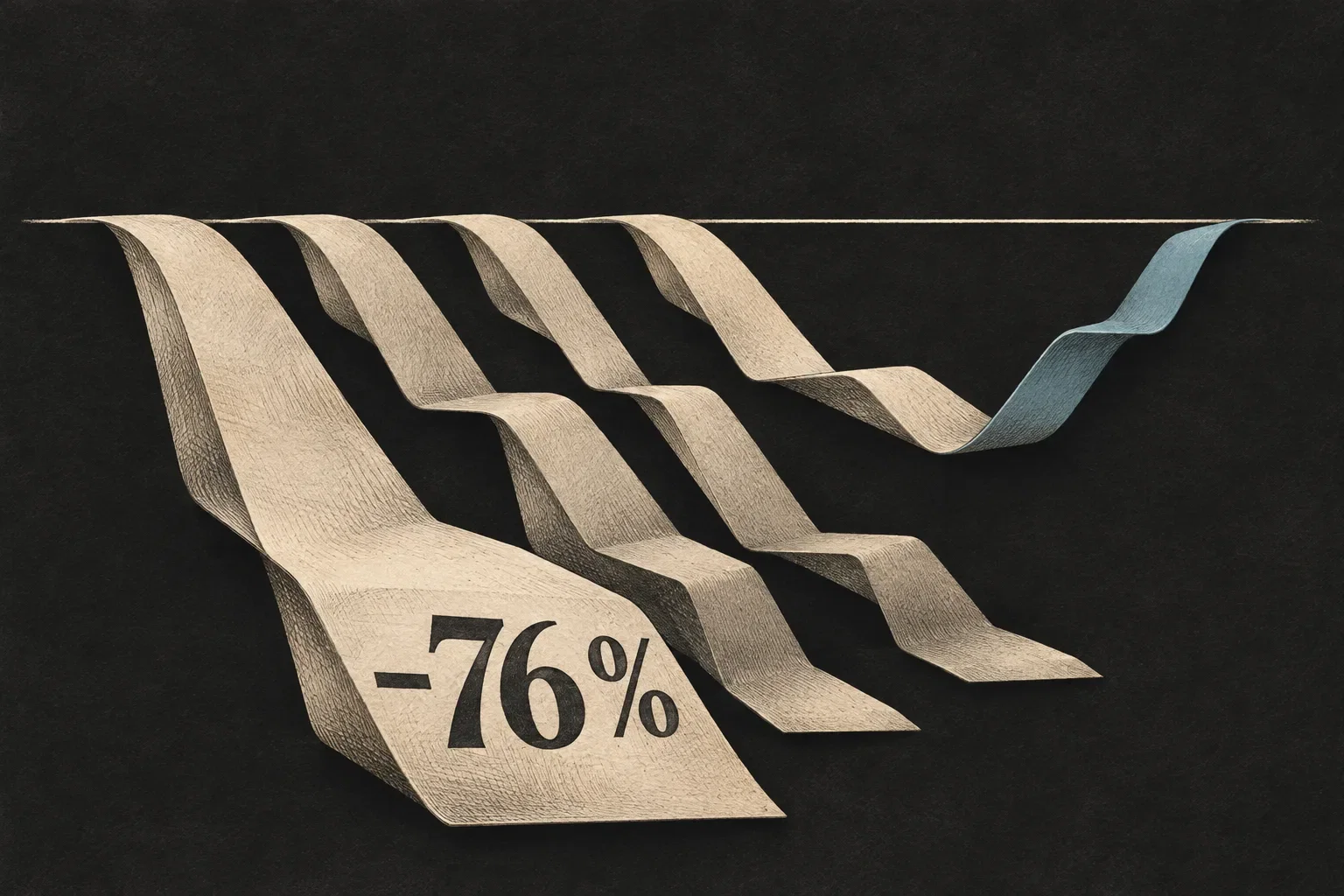
Large funds paid 25 EUR per share for a European defense company before its first trade. Today, it lost as much as 23% in a single day and is worth less than half that. A ticket seller from the same wave of debuts is 76% below its offering price - and yet it is reporting a profit.
Key points
Four major stock market debuts are trading today below the price funds paid before the first trade.
A European defense company lost as much as 23% in a single session after lowering its profitability outlook.
A ticket seller is 76% below its offering price, despite reporting a net profit of 33.6 million dollars.
Klarna has revenue growth of 27%, yet the market values it like an ordinary lending company.
Figma is voluntarily sacrificing some revenue and has itself announced slower growth next quarter.
The price funds paid no longer holds for any of them
The offering price is the amount large funds and banks pay for shares before they first trade on the stock exchange. Ordinary investors generally cannot get in at that price and buy later at a higher one, in the first minutes of trading. The latest crop of major stock market debuts has reversed that logic: all four companies in this article are now trading well below the price the first investors paid.
The latest case is unfolding today. European defense conglomerate CSG $CSG.AS , which listed on the Amsterdam exchange in January at 25 EUR, lowered its profitability outlook, and its shares lost as much as 23% during the session. Fintech company Klarna $KLAR , design software company Figma $FIG and ticket seller StubHub $STUB , three US debuts from last year, are 67%, 44% and 76% below their offering prices.
Company | Offering price | Price on 10. 11. | Vs. IPO | From peak | Valuation |
|---|---|---|---|---|---|
CSG | 25 EUR | 13,44 EUR | -46 % | -62 % | P/E 19,4 |
Klarna | 40 USD | 13,14 USD | -67 % | -66 % | P/S 1,2 |
Figma | 33 USD | 18,63 USD | -44 % | -59 % | P/S 6,5 |
StubHub | 23,50 USD | 5,65 USD | -76 % | -72 % | P/S 1,0 |
The only thing they have in common is that they disappointed. The reasons differ for each, as do the chances of a recovery: one is reporting a net profit and yet carries the steepest discount, while another was the most profitable of the four according to its prospectus and is now falling the fastest.
The defense company that lost a fifth of its value in one day
CSG published its nine-month figures this morning: revenue of 4,8 billion EUR (+6,1 %), a record order backlog of 18 billion EUR and a confirmed full-year revenue outlook of 7,4 to 7,6 billion EUR. But the market focused on other figures. Revenue for the third quarter alone fell to 1,51 billion EUR from 1,71 billion EUR a year earlier, and the operating margin dropped to 21 %. The company also lowered its full-year margin outlook from 24 to 25 % to around 21 %, as it sells off standard ammunition from inventory at lower prices while customers have shifted to more expensive, longer-range ammunition.
According to Bloomberg, the stock fell as much as 23% during the day, touching 10,35 EUR, its lowest level since its January debut. This was not the first blow: the shares fell below 25 EUR in March, and in May they were hit by a report from short seller Hunterbrook that questioned the company's business model. Net debt rose to 2,4 times EBITDA, and around 300 million EUR in revenue was pushed into the fourth quarter.
At the same time, it is the only company among these four that earns enough to be valued on profits. Based on the closing price on 10. 11., its P/E is 19,4 compared with 33,9 for the defense sector, and Bulios' fair value of 20,42 EUR was 52 % above the price. After today's plunge, multiples are even lower, but the question is how long the 21 % margin will hold.
The third quarter was shaped by timing and business mix. The revenue we expected in the third quarter will now be delivered in the fourth. Demand remains strong, including for medium- and large-caliber ammunition and land systems.
Michal Strnad, Chairman of the Board and CEO of CSG
Installments slowed by Germany
Klarna went public at 40 USD and today stands at 13,14 USD. Paradoxically, it was not bad figures that dragged it down. In the second quarter, it reported revenue of 1,042 billion USD, up 27 % from a year earlier, and net profit of 9 million USD. The stock still lost around a fifth of its value in a single day because the company lowered its full-year revenue outlook to 4,08 to 4,16 billion USD due to weak German consumers and announced the departure of its CFO.
At a P/S of 1,2, the market values Klarna like an ordinary lending company, not a fintech. Bulios' fair value is 20,04 USD, while analysts' consensus is 18,80 USD. The verdict will come on 17. 11. with the third-quarter results, for which analysts expect a loss of 0,15 USD per share. The key figure will be the share of delinquent loans: in the second quarter, provisions for credit losses amounted to 0,52 % of transaction volume.
Two US debuts the market is punishing for opposite reasons
Figma went public at 33 USD and closed its first day at 115,50 USD. Today it stands at 18,63 USD. For the third quarter, it reported revenue of 391,4 million USD, up 43 % from a year earlier, and a net loss of 81,3 million USD. The stock fell 7 % after the results because the company itself announced that growth would slow to 33 % in the fourth quarter. The reason is its own decision: it is giving customers more AI credits for the same price and knowingly sacrificing some revenue. It has a cushion of 1,7 billion USD in cash and virtually no debt; analysts' consensus is 27,40 USD.
We are seeing customers move from experimenting with AI to making bigger commitments, and Figma's agent is expanding the ways they use credits across our platform.
Praveer Melwani, Figma CFO
StubHub is the opposite story. It went public at 23,50 USD and today stands at 5,65 USD, or 76 % below its offering price. Yet in the third quarter it reported revenue of 502 million USD, adjusted EBITDA up 84 % to 124,1 million USD, net profit of 33,6 million USD and raised its full-year outlook for ticket sales volume. The market focused on one figure: adjusted earnings of 0,05 USD per share versus the expected 0,08 USD. The stock continued to fall in after-hours trading.
At a P/S of 1,0 and a free cash flow yield of 31,5 %, the market values StubHub like a company in trouble. The problem is its balance sheet: 1,3 billion USD in debt versus 1,2 billion USD in cash, some of which belongs to ticket sellers. Analysts' consensus of 10,75 USD is almost twice today's price.
What will determine who climbs back above the offering price
Each company has its own specific test and its own deadline:
Klarna, 17. 11.: provisions for credit losses above 0,52 % of transaction volume would mean that it is buying growth in volume with worse borrowers; stabilization in German volumes, on the other hand, would confirm that the summer selloff was overdone.
CSG, early 2027: full-year revenue in the range of 7,4 to 7,6 billion EUR and the promised release of working capital in the fourth quarter. If the delayed deliveries do not materialize even in Q4, the thesis of a cheap stock with a P/E below 20 will no longer hold either.
Figma, 17. 2. 2027: growth above 33 % and the share of customers who start paying for AI credits. Giving credits away for free only works if it turns into paid usage within two quarters.
StubHub, full-year results: adjusted EBITDA in the range of 400 to 420 million USD and further debt repayment. The company is already profitable; the market wants to see that its profits hold up outside concert season too.
The difference between the four battered debuts can be summed up simply. CSG's price fell because profits fell and investors do not know where margins will bottom out. StubHub's price fell while profits grew, so the 76 % discount applies to a company reporting a net profit whose operating profit grew by 84 %. Klarna and Figma are in between: they are growing, but at a price the market is not yet willing to pay. A lower price does not in itself mean lower risk, but for one of the four it means more profit for every dollar invested.